
Prophet story 3 of 30
نوح
Nuh
peace be upon him
The Ark, Patience, and a New Beginning
✦ Step Into the Story
🔮 What Do You Already Know?
No pressure — just guess! This helps you see how much you grow.
Nuh was sent to a people who had moved far away from the worship of Allah alone. The Qur’an describes his mission as extraordinarily long. He remained among his people for one thousand years minus fifty, calling them back to their Creator. That does not mean every day looked exactly the same. It means that generation after generation heard his message, and Nuh kept going with remarkable patience.
❓ How long was Prophet Nuh's mission?
He called his people publicly and privately. He spoke to them by night and by day. He reminded them that seeking Allah’s forgiveness would bring blessing. Yet many leaders rejected him. Some mocked the believers who followed him, especially because they were not the wealthy elite. Nuh did not reshape the truth to impress powerful people. He continued to deliver the message faithfully.
Eventually, Allah revealed to Nuh that no more of his people would believe beyond those who already had. Then came an unusual command: build an ark. Imagine constructing a huge vessel while people laughed and asked why it was being built. The Qur’an describes Nuh building the ark under Allah’s watch and guidance. Whenever chiefs passed by, they mocked him. Nuh answered that if they mocked the believers, a day would come when the truth of the warning would be clear.
❓ Where did Nuh get guidance to build the ark?
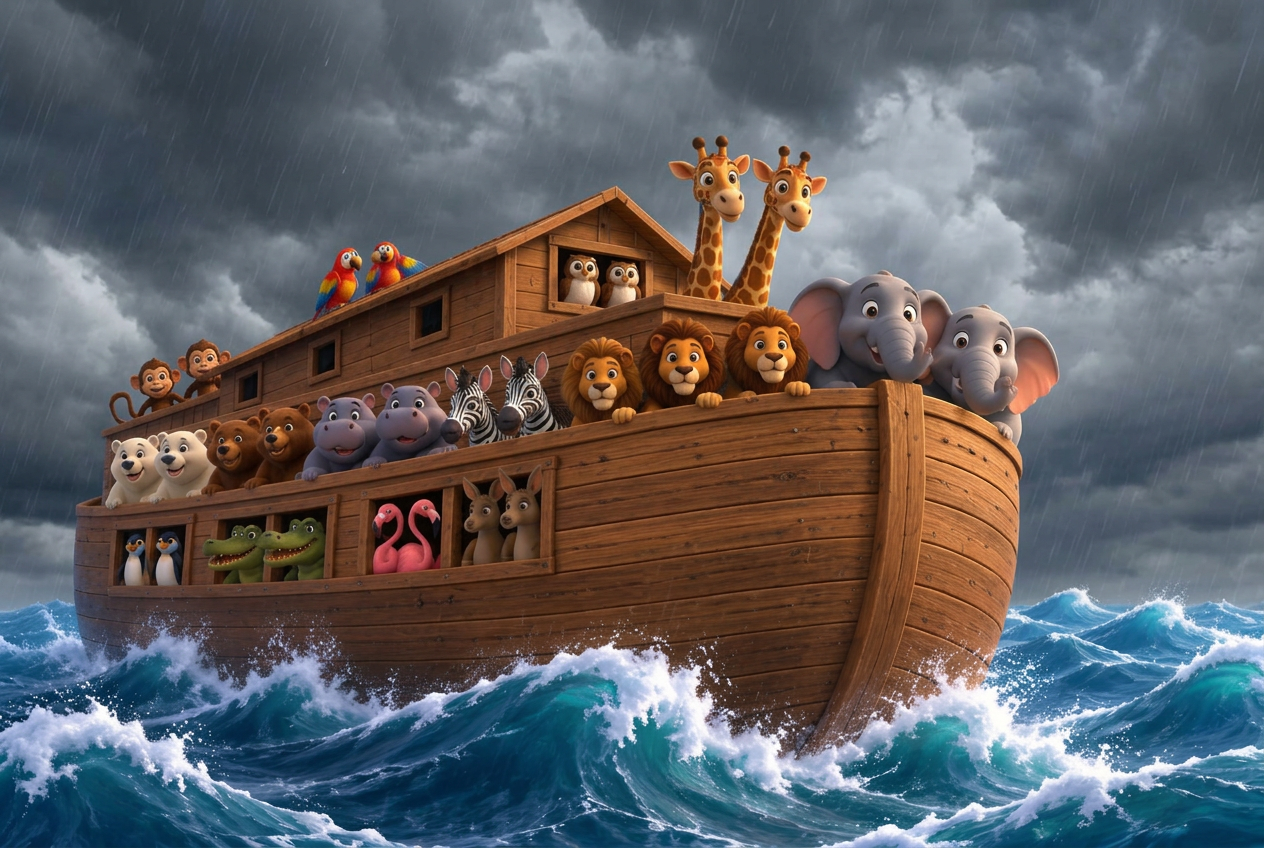
When Allah’s command arrived, water burst forth and rain poured down. Nuh was told to take aboard pairs of creatures and those of his family who were included in Allah’s promise, together with the believers. The Qur’an does not give a complete zoological inventory, exact dimensions, or a modern engineering plan for the ark. A responsible storybook should resist the temptation to invent those details as religious fact.

The flood became overwhelming. Waves rose like mountains. In one of the most emotional moments, Nuh saw a son who had refused faith. Nuh called to him to come aboard and not remain with the disbelievers. The son believed he could escape to a mountain. Nuh warned him that no one could be protected from Allah’s decree except those shown mercy. A wave came between them.
❓ Where did Nuh's son think he could hide?
Later, when the waters subsided, the ark came to rest on al-Judi. Nuh asked Allah about his son, thinking of the promise concerning his family. Allah taught him that family connection does not replace righteousness. Nuh immediately submitted, asked forgiveness for questioning what he did not fully understand, and sought refuge in Allah’s mercy.
❓ Where did the ark come to rest?
Nuh’s story is about far more than a flood. It is about courage when almost no one agrees with you. It is about refusing to measure truth by popularity. It is about a prophet who cared for his people even while they insulted him. It is about a family test that shows each person is responsible for faith.
The ark is also a strong symbol for children: when Allah gives guidance, safety comes from obeying Him, not from feeling powerful. The son saw a mountain and trusted its height. Nuh trusted Allah. The story asks the reader a quiet question: when life becomes confusing, what do you rely on?

The miracle spotlight includes the divinely commanded rescue of Nuh and the believers through the ark and the extraordinary flood that punished persistent rejection. Yet the chapter should avoid turning the disaster into entertainment. The focus is on warning, mercy, obedience, and consequence.
A fun picture sequence can show only environments and objects: dark clouds gathering over an ancient landscape; wooden beams and tools near a growing ark; pairs of animals approaching; high water surrounding distant hills; calm skies over the resting ark. Nuh himself should never appear.
Children can also learn about perseverance by making a paper “950” and filling it with tiny marks. Even a few hundred marks take patience. That visual helps them understand how astonishingly long Nuh continued his mission.
❓ What determines success for a prophet?
Nuh’s final legacy is hope mixed with seriousness. He tried every respectful way to reach people. He did not quit because the results were small. Success for a prophet is not measured only by numbers; it is measured by faithfulness to the mission. That is a lesson any child can use: do what is right, speak kindly, be patient, and leave the results to Allah.
✨ Miracle Spotlight
Allah commanded the ark, saved Nuh and the believers through the flood, and fulfilled the warning after generations of rejection.
🌙 Pause & Imagine
Close your eyes for ten seconds and imagine the environment from this story without imagining the prophet’s appearance. What do you hear: wind, animals, water, tools, footsteps, or a busy marketplace? What colors would the sky, stone, sand, wood, or plants have looked like? The goal is to enter the setting while keeping the prophet respectfully unseen.
💡 Did You Know?
Prophetic stories in the Qur’an are not arranged as one ordinary history textbook. The same prophet may appear in several surahs, with each passage highlighting a different lesson. That is why good storytelling should connect verses carefully instead of pretending every detail appears in one place.
🔤 Arabic Word Discovery
Sabr
patience
“I show sabr when I keep trying even if it is hard.”
✨ Story questions: 0 / 5
🎓 What Did You Learn?
Finish the story first, then test what you learned.
Real-Life Mission
Keep working on something difficult without giving up.
🛂 Finish reading to earn this stamp.
💡 What can we learn?
🏮 Trivia quiz
1. What did Nuh call his people to?
2. Did everyone listen?
3. What did Allah command Nuh to build?
4. What happened to Nuh’s son who refused to board?
5. Where did the ark come to rest?
🖼 Picture match
Tap a word on the left, then its match on the right.
🧭 Order the story
Tap the events in the right order.
🎯 Multiple choice
❓ How did Nuh call his people to Allah?
⚖️ True or false
Nuh reshaped the truth to make it more appealing to the wealthy leaders.
🔍 Find the clue
🌱 Reflection: What can I learn?
“From Nuh, I want to practice…”
🌟 Famous Stories
A Father's Call 📖 Qur'anSurah Hud 11:42-46
As the great Ark floated on waves as high as mountains, Prophet Nuh, peace be upon him, was safe inside with the believers. From the deck, he could see his son, who had refused to believe, trying to find safety from the rising water. It was a test for Prophet Nuh's heart, as he watched his own child face the consequences of disbelief.
The Qur'an tells us that Nuh (peace be upon him) called out, “O my son, come ride with us and do not be with the disbelievers.” But his son foolishly replied, “I will take refuge on a mountain to protect me from the water.” Prophet Nuh (peace be upon him) tried to warn him that nothing could save him except the mercy of Allah. But before he could finish, a mighty wave rose up between them, and his son was among those who were drowned.
Filled with grief, Nuh (peace be upon him) turned to his Lord in prayer, mentioning that his son was his family. Allah taught him, and us, a powerful lesson. He replied that the son was not truly of his family because his actions were not righteous. This showed that the true bonds of family are based on faith and good deeds, and we must always accept Allah's perfect wisdom and justice.
💡 Lesson: Our connection to Allah through faith and good deeds is more important than any other relationship.
❓ Quick questions
Question 1 / 3
Why did the son of Nuh (peace be upon him) refuse to get on the Ark?
Success on the Day of Judgment 📜 Authentic hadithSahih al-Bukhari 3340
The Prophet Muhammad (peace and blessings be upon him) once told his companions about what he was shown of the Day of Judgment. He described how the prophets would come one by one with their followers. He saw a prophet who had a large nation of believers with him. Then he saw other prophets who had only a small group with them. Then, he saw a prophet who had only ten followers, and another with only five, and even a prophet who would come all alone, because not a single person from his community had believed him.
This hadith makes us think of the incredible patience of Prophet Nuh, peace be upon him. The Qur'an tells us that he preached the message of the One True God to his people for 950 years. For nearly a thousand years, he warned them, guided them, and called them to Allah, day and night, in public and in private. He never stopped, even when they laughed at him, mocked him, and rejected his call.
Despite his long and patient efforts, only a very small number of people believed and joined him on the Ark. But in the eyes of Allah, Prophet Nuh (peace be upon him) was one of the most successful messengers. His success wasn't measured by how many people followed him, but by his perfect obedience and unwavering patience in delivering the message exactly as Allah commanded.
💡 Lesson: True success is about obeying Allah with patience, not about how many people follow you.
❓ Quick questions
Question 1 / 3
For how long did Prophet Nuh (peace be upon him) preach to his people?
🤲 Prophetic Dua
رَّبِّ ٱغْفِرْ لِى وَلِوَٰلِدَىَّ وَلِمَن دَخَلَ بَيْتِىَ مُؤْمِنًۭا وَلِلْمُؤْمِنِينَ وَٱلْمُؤْمِنَٰتِ وَلَا تَزِدِ ٱلظَّٰلِمِينَ إِلَّا تَبَارًۢا
Transliteration: Rabbigh fir lee wa liwaa lidaiya wa liman dakhala baitiya mu'minanw wa lil mu'mineena wal mu'minaati wa laa tazidiz zaalimeena illaa tabaaraa
Meaning: My Lord, forgive me and my parents and whoever enters my house a believer and the believing men and believing women. And do not increase the wrongdoers except in destruction."
Who said it: Nuh · Nooh 71:28
📖 Where Is This Story in the Qur'an?
👪 For parents & teachers
Qur'an references: Hud 11:25–49; Nuh 71:1–28; Al-Mu’minun 23:23–30; Al-‘Ankabut 29:14–15
Detail notes: Stories are based on the Qur'an first. Where a detail comes from hadith or later historical reports, the text says so. Please review with a trusted teacher.
Translations are provided for learning. For Qur'anic wording, refer to an approved Qur'an translation in your language.