
Prophet story 4 of 30
هود
Hud
peace be upon him
Standing Firm When a Powerful People Became Proud
✦ Step Into the Story
🔮 What Do You Already Know?
No pressure — just guess! This helps you see how much you grow.

Hud was sent to the people of ‘Ad, a powerful nation remembered in the Qur’an for strength and impressive building. They lived after the people of Nuh and became proud of their physical power. Their civilization gave them confidence, but confidence slowly turned into arrogance. They worshiped other than Allah and acted as though their strength made them safe from accountability.
❓ Who lived before the people of ‘Ad?
Hud addressed them as his own people. He did not come as a stranger who hated them. He cared about them and called them to worship Allah alone. He asked for no payment for delivering the message. He reminded them that the One who had given them strength could also take it away.
The leaders rejected him. They accused him of foolishness and lying. Hud answered calmly that he was not foolish; he was a messenger from the Lord of the worlds. That exchange is important for children because it shows a prophet responding to insults without becoming cruel. Hud did not need to win an argument by shouting. He needed to speak the truth clearly.
❓ How did Hud respond to the leaders' insults?
The people of ‘Ad were proud of their size and power. The Qur’an records their boast: “Who is stronger than us in strength?” The answer is built into the verse: Allah, who created them, was stronger. Their mistake was not being strong. Strength can be a blessing. Their mistake was thinking strength made them independent of the One who gave it.

Hud urged them to seek forgiveness and turn back to Allah. He told them that doing so would bring rain and add strength to their strength. This is another recurring Qur’anic lesson: repentance is not humiliation; it is a path to mercy.
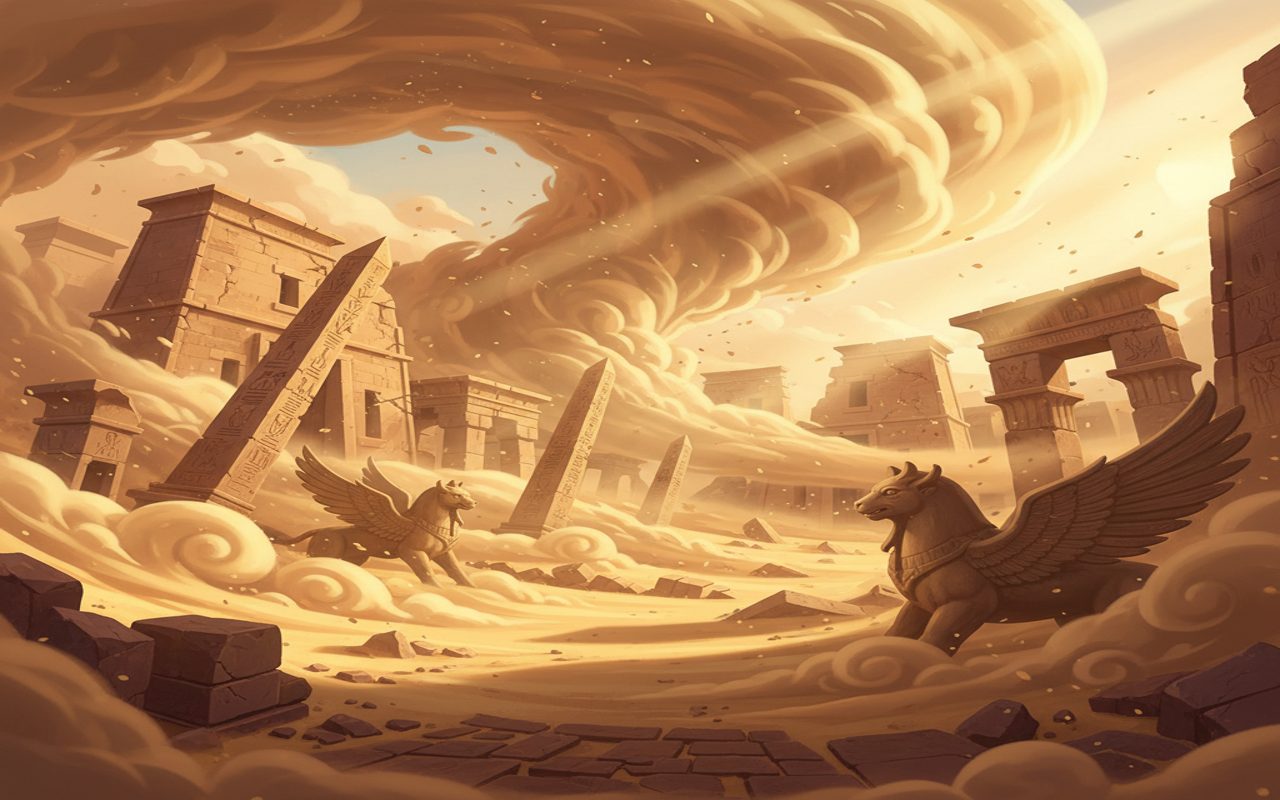
Eventually, the warning became reality. The Qur’an describes a furious, intensely cold wind sent against ‘Ad for seven nights and eight days. It tore through their land relentlessly. The people who once felt unmovable were left fallen. Hud and those who believed were saved by Allah’s mercy.
❓ How long did the furious wind last?
The story should not be illustrated with injured people or frightening bodies. Instead, show the ancient landscape before and after: towering stone structures, vast desert plains, heavy clouds, bending palms, violent wind sweeping through abandoned architecture, and then a quiet sunrise over the land.
Hud’s miracle spotlight is connected to Allah’s protection of the believers and the extraordinary punishment that came exactly after repeated warning. Hud did not control the wind. The event came by Allah’s command.
A child-friendly activity can explore “strong things.” Ask: Is a mountain strong? Is steel strong? Is a storm strong? Then ask: Who created all of them? The exercise turns the central mistake of ‘Ad into a lesson about humility.
The story also teaches something about buildings. The Qur’an criticizes ‘Ad for building monumental structures in a boastful way. Architecture itself is not wrong. Beautiful buildings can serve people. The problem is when achievements become tools of pride, waste, or oppression. A child who builds an amazing block tower can still say, “Alhamdulillah, Allah gave me the ability to learn and build.”
❓ What was the problem with ‘Ad’s buildings?
Hud’s story is shorter than Musa’s or Yusuf’s, and the Qur’an does not provide names of kings, exact city maps, or a complete political history of ‘Ad. Those gaps should remain gaps. The lesson is already strong: societies can become technically impressive but morally weak.
❓ What kind of history does the Qur’an leave out?
At the end, Hud’s message can be summarized in a sentence children can remember: **Real strength is not pretending you need no one; real strength is using Allah’s gifts with gratitude and obedience.**
The people of ‘Ad looked powerful from the outside. Hud taught that the inside matters more. Faith, humility, justice, and gratitude are the kind of strength that lasts.
✨ Miracle Spotlight
Allah rescued Hud and the believers and sent the overwhelming wind after repeated rejection by ‘Ad.
🌙 Pause & Imagine
Close your eyes for ten seconds and imagine the environment from this story without imagining the prophet’s appearance. What do you hear: wind, animals, water, tools, footsteps, or a busy marketplace? What colors would the sky, stone, sand, wood, or plants have looked like? The goal is to enter the setting while keeping the prophet respectfully unseen.
💡 Did You Know?
Prophetic stories in the Qur’an are not arranged as one ordinary history textbook. The same prophet may appear in several surahs, with each passage highlighting a different lesson. That is why good storytelling should connect verses carefully instead of pretending every detail appears in one place.
🔤 Arabic Word Discovery
Tawadu'
humility, not showing off
“Tawadu' means I don't brag about what I have.”
✨ Story questions: 0 / 5
🎓 What Did You Learn?
Finish the story first, then test what you learned.
Real-Life Mission
Do something kind without telling anyone.
🛂 Finish reading to earn this stamp.
💡 What can we learn?
🏮 Trivia quiz
1. Hud was sent to which people?
2. What quality caused them trouble?
3. What did they boast about?
4. What form did the punishment take?
5. What should we do when we are talented or strong?
🖼 Picture match
Tap a word on the left, then its match on the right.
🧭 Order the story
Tap the events in the right order.
🧩 Think about it
Build a “strong foundation” tower by matching blocks: gratitude, honesty, kindness, prayer, humility.
🎯 Multiple choice
❓ According to the people of ‘Ad, who was stronger than them?
⚖️ True or false
Hud asked the people for payment in exchange for his message.
🔍 Find the clue
🌱 Reflection: What can I learn?
“From Hud, I want to practice…”
🌟 Famous Stories
Who is Mightier Than Us? 📖 Qur'anFussilat 41:15, Al-A'raf 7:69
The people of 'Ad, to whom the Prophet Hud (peace be upon him) was sent, were incredibly strong and powerful. They were famous for building tall towers and magnificent buildings in high places, just to show off. They were so proud of their might that they felt no one on earth could ever defeat them. They would boast and ask, as the Qur'an tells us, "Who is mightier than us in strength?"
Hud (peace be upon him) came to them with a simple and important message. He reminded them to worship Allah alone, the One who had created them and given them all their blessings. He told them not to be arrogant with the gifts Allah had given them. He warned them that building things for show and being proud of their power was wrong. Instead, they should be grateful to Allah and use their strength for good.
When they boasted about their power, Hud (peace be upon him) reminded them of a simple truth. He told them that Allah, who created them in the first place, was far mightier than they were. Their strength was nothing compared to the power of their Creator. He warned them that if they continued in their pride and disbelief, a terrible punishment from Allah would come to them.
💡 Lesson: True strength comes from Allah, and we should always be humble and grateful for the blessings He gives us.
❓ Quick questions
Question 1 / 3
What were the people of 'Ad famous for building?
The Deceiving Cloud ❔ Traditional reportReported in classical tafsir (Ibn Kathir, Al-Tabari) on Al-Ahqaf 46:24-25
Because they rejected Prophet Hud (peace be upon him) and the message of Allah, the people of 'Ad were punished with a long drought. For a long time, no rain fell. The land became dry and barren, and the people grew desperate. They needed water for themselves, their animals, and their crops. They started to look to the sky, hoping and praying for rain to come and save them.
One day, they saw a huge, dark cloud appearing in the distance, moving toward their valley. They became overjoyed and started to celebrate. They ran out of their homes, pointing to the sky and shouting with happiness. The Qur'an tells us they said, "This is a cloud which will bring us rain!" They believed that their hardship was finally over and that they were about to receive a great blessing.
But Hud (peace be upon him) knew the truth. This was not a cloud of mercy. He told them that this was the very punishment they had impatiently asked for. It was not rain, but a terrifying, furious wind sent by Allah. The Qur'an describes how this wind blew for seven nights and eight days, destroying the people of 'Ad and everything they had built. The happy cloud they saw was actually their destruction.
💡 Lesson: Things are not always as they seem, and we should trust that Allah's plan is perfect, even when we don't understand it.
❓ Quick questions
Question 1 / 3
Why were the people of 'Ad experiencing a drought?
🤲 Prophetic Dua
No specific personal dua of this prophet is recorded in the Qur'an. We don't invent one — try the duas of other prophets!
📖 Where Is This Story in the Qur'an?
👪 For parents & teachers
Qur'an references: Al-A‘raf 7:65–72; Hud 11:50–60; Al-Haqqah 69:6–8; Fussilat 41:15–16
Detail notes: Stories are based on the Qur'an first. Where a detail comes from hadith or later historical reports, the text says so. Please review with a trusted teacher.
Translations are provided for learning. For Qur'anic wording, refer to an approved Qur'an translation in your language.