
🧭 Learning Adventure — not a prophet chapter
Chapter 42 · 🐫
Ancient Arabia Before Islam
A Land of Sand, Stars, and Stories
The Life of the Desert Tribes
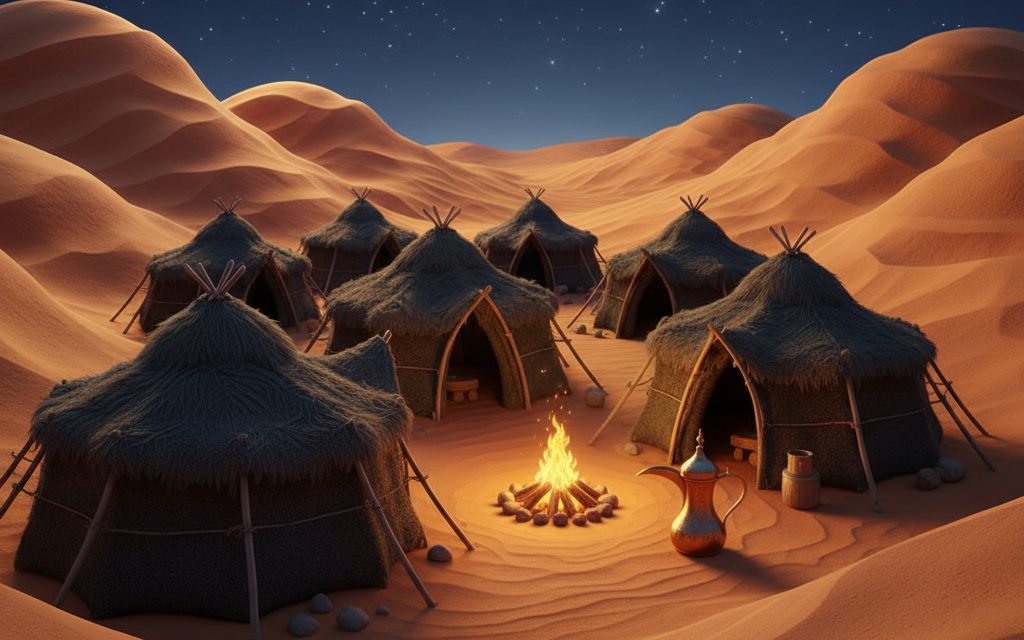
In the vast, golden deserts of ancient Arabia, life was shaped by the shifting sands and the bright stars above. People lived in groups called tribes, moving from place to place to find water and grass for their animals. Their homes were sturdy tents made of dark goat hair, which stayed cool during the scorching day and warm during the chilly desert nights.
Loyalty to one’s tribe was the most important rule of the desert. Because there was no single government, members of a tribe protected one another like a giant, extended family. They were famous for their incredible hospitality; if a traveler arrived at their tent, they would share their best food and milk, even if they didn't have much for themselves.
❓ What was the main reason tribes moved from place to place?
Caravans and the Fragrant Trade
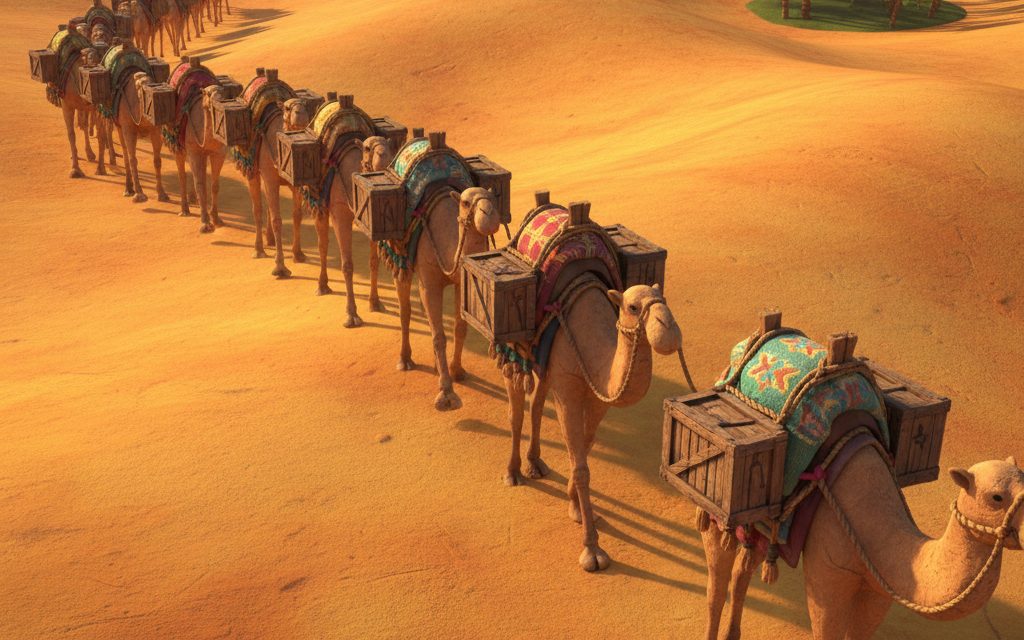
Arabia sat at the heart of the world's great trade routes. Brave merchants organized massive caravans—long lines of hundreds of camels—to carry precious goods across the dunes. They traveled north toward Syria in the summer and south toward Yemen in the winter, carrying spices, perfumes, and expensive silks that smelled of frankincense.
Makkah was a very important stop on these routes. It wasn't just a place for business; it was a sanctuary where the Zamzam well provided life-giving water to thirsty travelers. These journeys were dangerous due to the heat and bandits, so the merchants relied on their deep knowledge of the constellations to navigate the trackless desert at night.
🤔 Stop and Think
If you were traveling across a desert with no GPS or maps, what signs in nature would you look for to find your way?
❓ Which two directions did the caravans travel according to the seasons?
The Power of the Spoken Word
Even though most people didn't read or write, they were masters of the Arabic language. Poetry was their favorite art form, and a great poet was celebrated like a hero. Every year at the Ukaz market, poets would compete to see who could recite the most beautiful and powerful verses, describing the bravery of their ancestors and the beauty of their camels.
The best poems were said to be written in gold and hung on the walls of the Kaaba. Language was so important that a single word could start a war or bring two tribes together in peace. They took great pride in their memory, memorizing thousands of lines of poetry and long lists of their family ancestors going back many generations.
❓ Where were the most famous poems reportedly displayed?
Pilgrimage and the Kaaba
For centuries, people from all over the Arabian Peninsula traveled to Makkah for pilgrimage. They knew the Kaaba was a sacred house built by Prophet Ibrahim and his son Ismail (peace be upon them). Even before Islam, there were four sacred months every year when fighting was strictly forbidden, allowing everyone to travel safely for trade and worship.
💡 Did You Know?
The 'Ship of the Desert'—the camel—can drink up to 40 gallons of water at once and survive for weeks without a fresh drink!
However, over time, people had forgotten the true message of Tawhid (believing in one God). They had filled the area around the Kaaba with idols made of stone and wood, wrongly asking these statues for help. While they still respected the sanctuary, the original pure teachings of Ibrahim (peace be upon him) had become clouded by these invented traditions.
❓ Who originally built the Kaaba?
Social Challenges and the Need for Change
Despite their bravery and poetry, life in Arabia before Islam—a time called the Jahiliyyah—had many problems. There was no law to protect the weak, the poor, or the orphans. Small arguments between tribes could lead to wars that lasted for decades, and unfortunately, some people treated women and young girls very unkindly.
The society was waiting for a light to guide them back to justice and the worship of Allah alone. They had the foundations of courage and generosity, but they needed a teacher to show them how to use those qualities for good. The stage was being set for the final Messenger, Muhammad ﷺ, to bring the message that would change the world forever.
🔎 Source Check
Tribal life, trade routes, and poetry are documented in general history and Seerah. The winter and summer caravan routes are mentioned in the Qur'an. The presence of idols and the sacred months are recorded in Hadith and Seerah literature. Dates for specific tribal wars are approximate.
✨ Story questions: 0 / 4
💡 What can we learn?
🏮 Trivia quiz
1. What does 'Jahiliyyah' mean?
2. What was the name of the famous well in Makkah?
3. What animal was the most essential for desert travel?
🖼 Picture match
Tap a word on the left, then its match on the right.
🧭 Order the story
Tap the events in the right order.
🎯 Multiple choice
❓ Why were the four sacred months important?
⚖️ True or false
Ancient Arabs mostly recorded their history in large stone libraries.
🔍 Find the clue
🌱 Reflection: What can I learn?
Arabs were known for being very generous to guests. How can you show kindness and generosity to someone who visits your home today?
🗣 Teach it back
Can you describe what a busy market day in ancient Makkah might have looked, smelled, and sounded like?
📖 Find it in the Qur'an
106:1-2